Case Study
Church Sound Academy: Training Platform for Volunteer Sound Teams
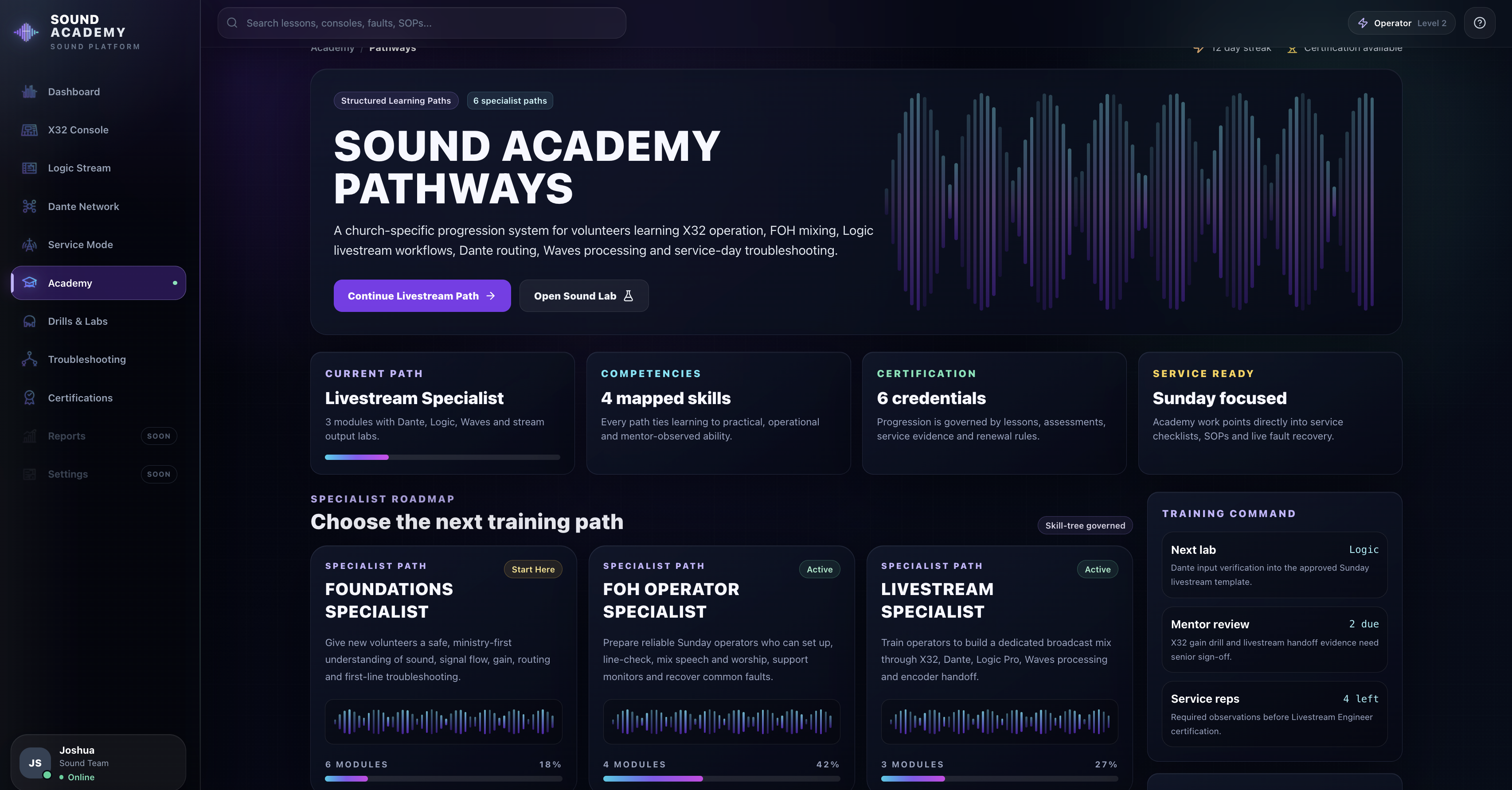
Church sound desks usually run on tribal knowledge: a couple of experienced operators hold everything in their heads, and new volunteers learn by watching. I built a platform that turns that knowledge into structured learning paths, an interactive model of the church's real mixing console, and certification tracking — so teams can onboard, operate, and recover from faults with confidence. It is my largest build to date and I owned the domain model, data layer, and UI end to end.
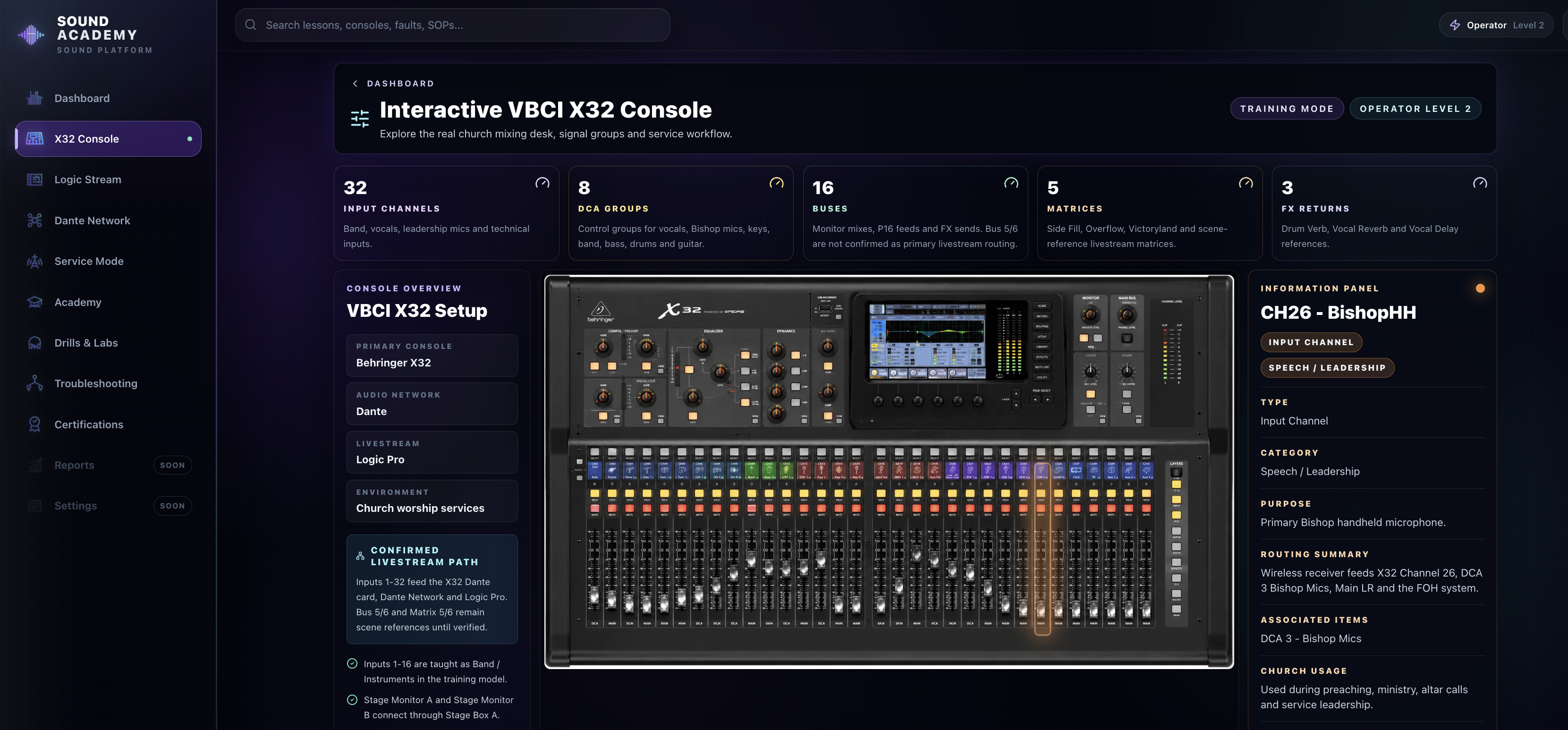
An interactive model of the church's real Behringer X32: selecting a channel reveals its type, routing summary, associated DCA groups, and how it is used during services.
Problem and goal
Volunteer sound teams face a real training gap. The equipment is complex, services are live with no second take, and knowledge tends to live with one or two people. When they are away, quality drops or the stream goes down.
The goal was to make that knowledge learnable and repeatable: structured pathways for different roles, an accurate reference for the exact desk and signal flow the church uses, and a way to evidence competency before someone runs a service alone.
It also had to reflect reality. Rather than generic tutorials, the platform is modelled on the church's actual console, routing, Dante network, and livestream workflow.
Challenge and solution
The core challenge was turning a physical, analog-feeling workflow into a coherent data model. I mapped the real desk into structured entities — input channels, DCA groups, buses, matrices, and FX returns — with routing relationships between them, then layered learning pathways and certification progression on top through a Prisma schema built to move from SQLite locally to PostgreSQL in production without rework.
Core product decisions
Model the real console
Instead of generic diagrams, the platform encodes the church's actual X32 setup so operators learn the exact channels, routing, and DCA groups they will use on Sunday.
Role-based pathways
Specialist tracks — Foundations, FOH Operator, and Livestream Specialist — give each volunteer a clear progression with modules, labs, and measured completion.
Evidence-led certification
Progression is governed by lessons, assessments, service evidence, and mentor sign-off, so a certification reflects real, observed ability rather than clicks.
Service-day readiness
Academy work points directly into service checklists, SOPs, and live fault recovery, closing the gap between learning and running an actual service.
What this project demonstrates
- Modelling a complex real-world domain into structured, queryable data.
- Designing a Prisma schema that scales from a local SQLite MVP to PostgreSQL in production.
- Building and organising a large Next.js App Router codebase across many feature areas.
- Turning tacit expert knowledge into a structured, teachable, and certifiable system.
Next improvements
- Ship the PostgreSQL production deployment with authenticated multi-user accounts.
- Expand the Sound Lab with more generated listening and mixing exercises.
- Add mentor dashboards for reviewing service evidence and sign-off.
- Broaden the console model to cover additional venues and desks.
Product walkthrough screenshots
From the interactive console reference through the structured specialist learning pathways.